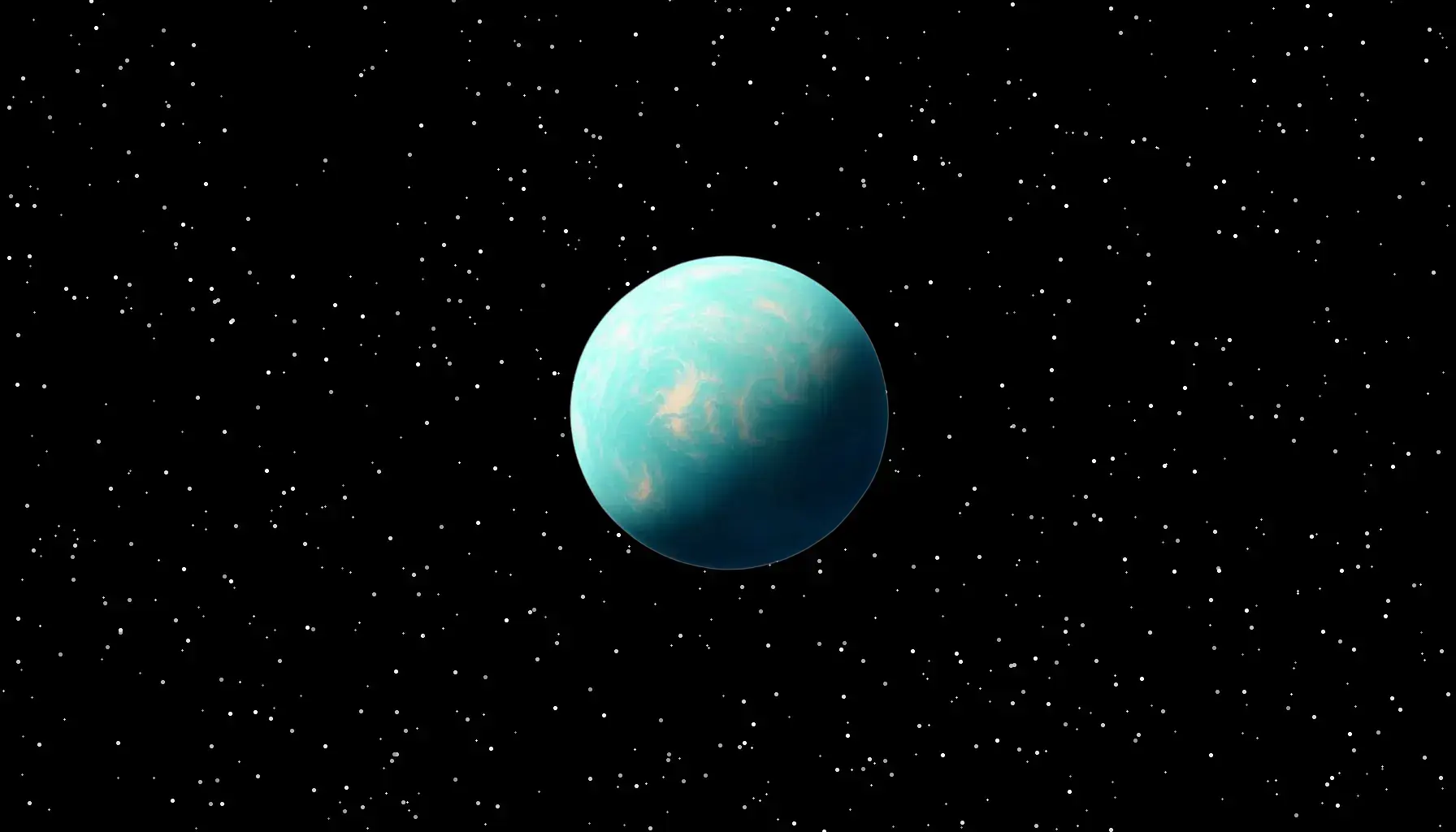
Definition and context
Thermocryas are giant planets whose energy input lies between cold Borealis-type ice giants and ultra-hot Pyrogiants. They receive more stellar radiation than Borealis but not enough to drive extensive atmospheric ionization.
Composition and chemistry
Interiors remain dominated by water (H₂O), methane (CH₄), and ammonia (NH₃) at higher temperatures and pressures than in classical ice giants. In upper layers, prolonged irradiation can partially dissociate methane and form complex organics, shifting atmospheric color and spectral properties.
Atmosphere and dynamics
Thermal conditions destabilize typical Borealis ice clouds. The atmosphere becomes more dynamic, with intense winds, rapidly evolving cloud fields, and active convection. Water and ammonia may persist as supercritical fluids or dense vapors, powering complex meteorology.
Internal structure and magnetism
A volatile-rich envelope surrounds a dense, likely rocky core. Warmer intermediate layers can become partly fluid, altering internal dynamics and the potential for dynamo action and magnetic-field generation.
Evolutionary role
As transitional worlds, Thermocryas may cool toward Borealis-like states or, if migration or irradiance increases, evolve toward Pyrogiants. Mass, orbit, and stellar type govern the pathway.
Significance
They highlight that planetary classes are not fixed but reflect continuous thermodynamic and chemical transitions. Studying them clarifies evolutionary diversity among giant worlds.