Definition
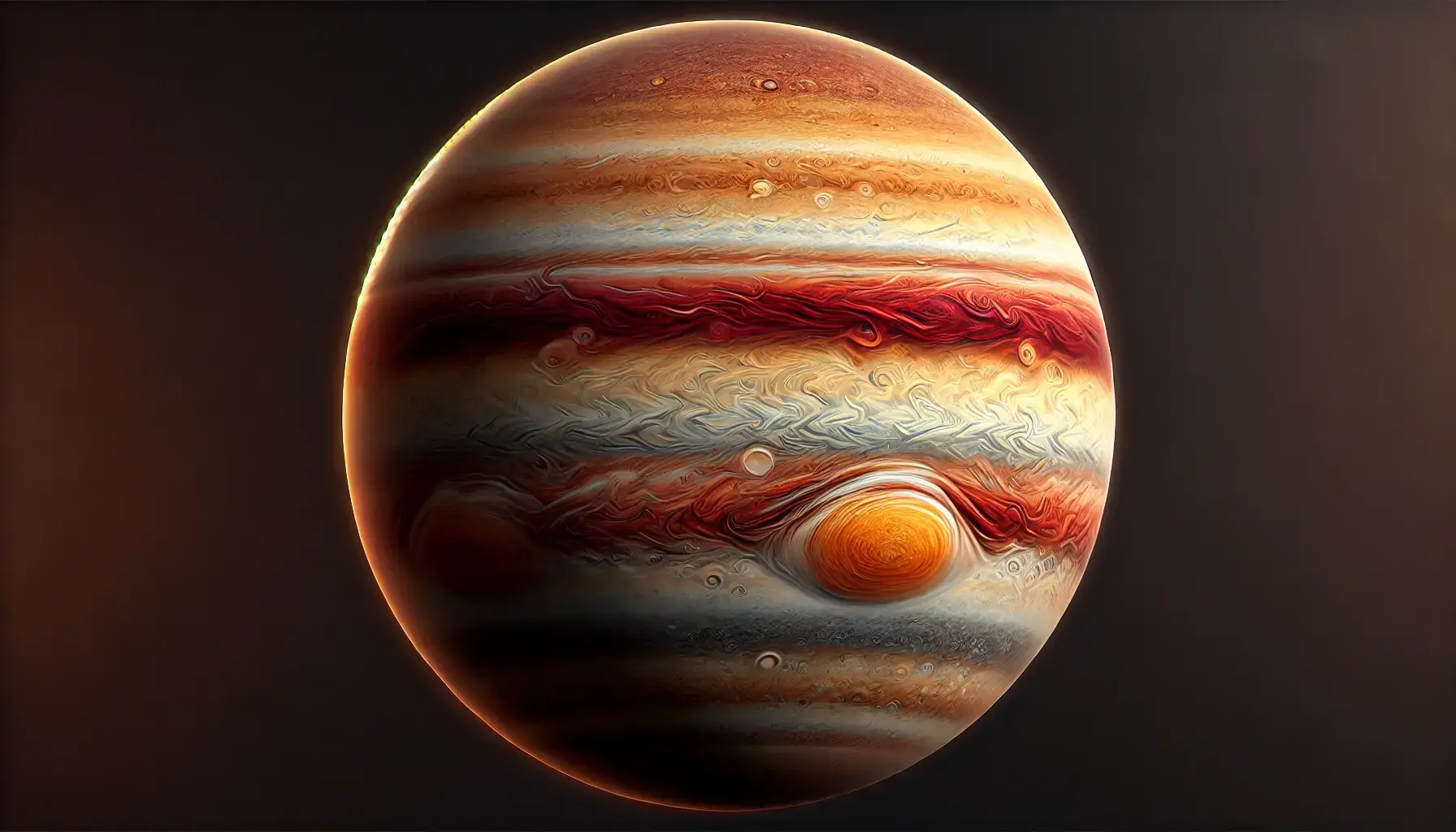
Pyrogiants are huge gas planets located at short orbital distances from their star. Intense stellar radiation drives high surface temperatures that place the atmosphere in partial ionization and produce physical phenomena absent in more distant gas giants.
Structure
Internally they resemble other gas giants, with a dense core surrounded by layers of hydrogen and helium. However, extreme conditions in the upper atmosphere inhibit stable condensation of elements. Many substances that would normally be solid or liquid remain gaseous, including iron, titanium, and sodium. These elements create spectroscopically detectable signatures and are often present in ionized form.
Atmospheric Processes
Large contrasts between the day-side and night-side hemispheres generate very strong thermal gradients. As a consequence, supersonic winds traverse the upper atmosphere, reaching several kilometers per second. This circulation redistributes heat but does not always equalize temperatures, leading to significant differences in thermal structure.
Interactions with Radiation
High temperatures combined with ionized species promote strong coupling between the atmosphere and stellar radiation. This produces distinctive spectra that enable studies of chemistry, plasma dynamics, and energy transport in these extreme planets.
Scientific Significance
Observations of Pyrogiants provide a natural laboratory for probing the limits of planetary atmospheres, revealing processes in plasma physics, high-temperature chemistry, and atmospheric dynamics under extreme forcing by stellar energy.