Definition
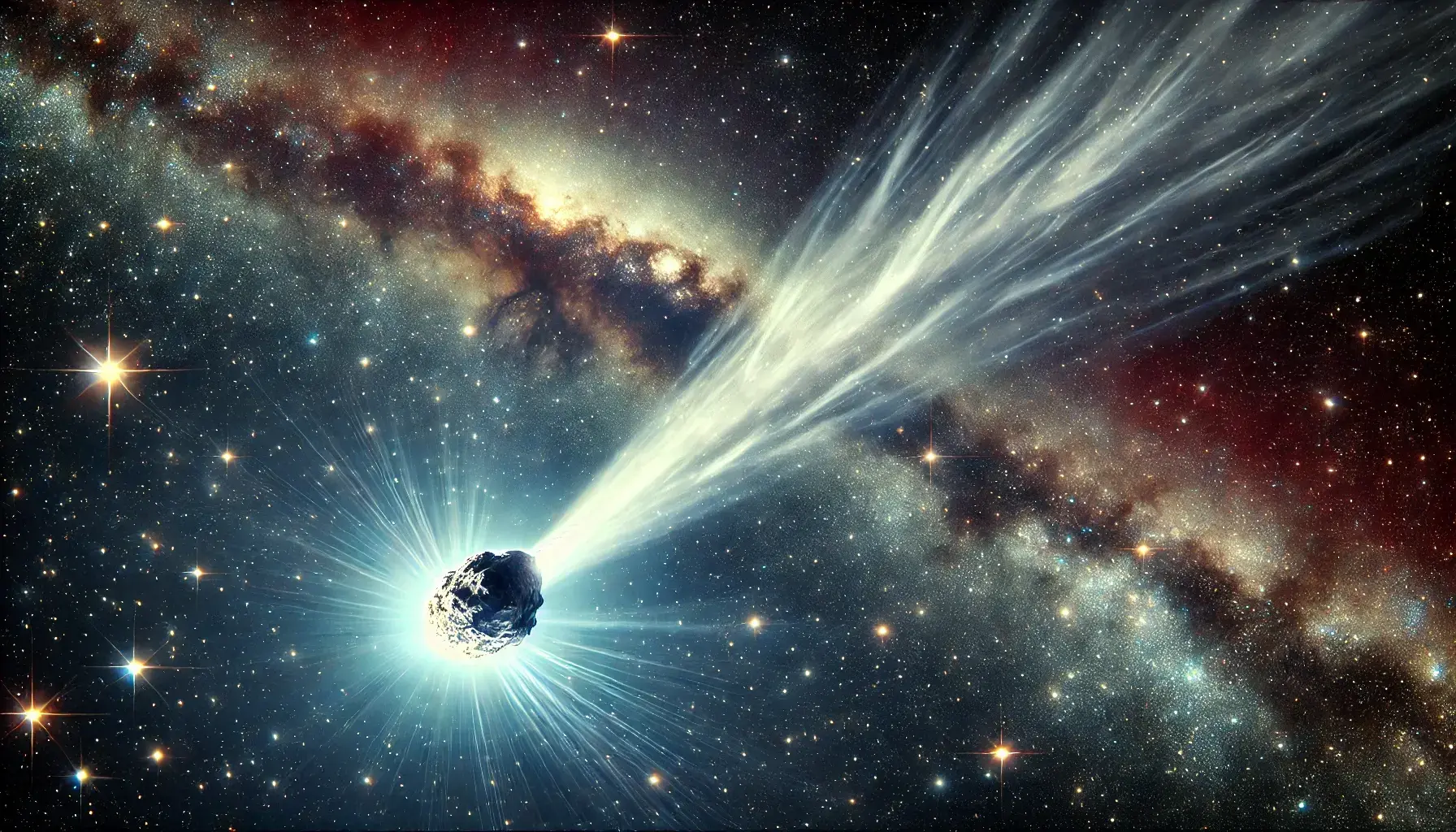
A non-periodic comet is a celestial body made of ice, dust, and volatile compounds following an open trajectory (hyperbolic or parabolic). Unlike periodic comets, its orbit does not allow regular returns near the Sun.
Structure
Its nucleus is composed of ice mixed with rocks and minerals. As it approaches the Sun, heat causes ice sublimation, forming a bright coma and often one or more tails.
Origin and Trajectory
In our Solar System, such comets originate mainly from the Oort Cloud, a very distant spherical reservoir about 1 light-year away. Their orbits are perturbed by gravitational influences, leading them through the inner solar system only once.
Interaction with the Solar System
During close passage to the Sun, comets experience intense thermal and dynamic activity. Solar winds alter their tail and disperse part of their material.
Evolution and Ejection
After their single approach, gravitational interactions with planets (especially Jupiter) can eject the comet from the solar system into interstellar space.