Definition
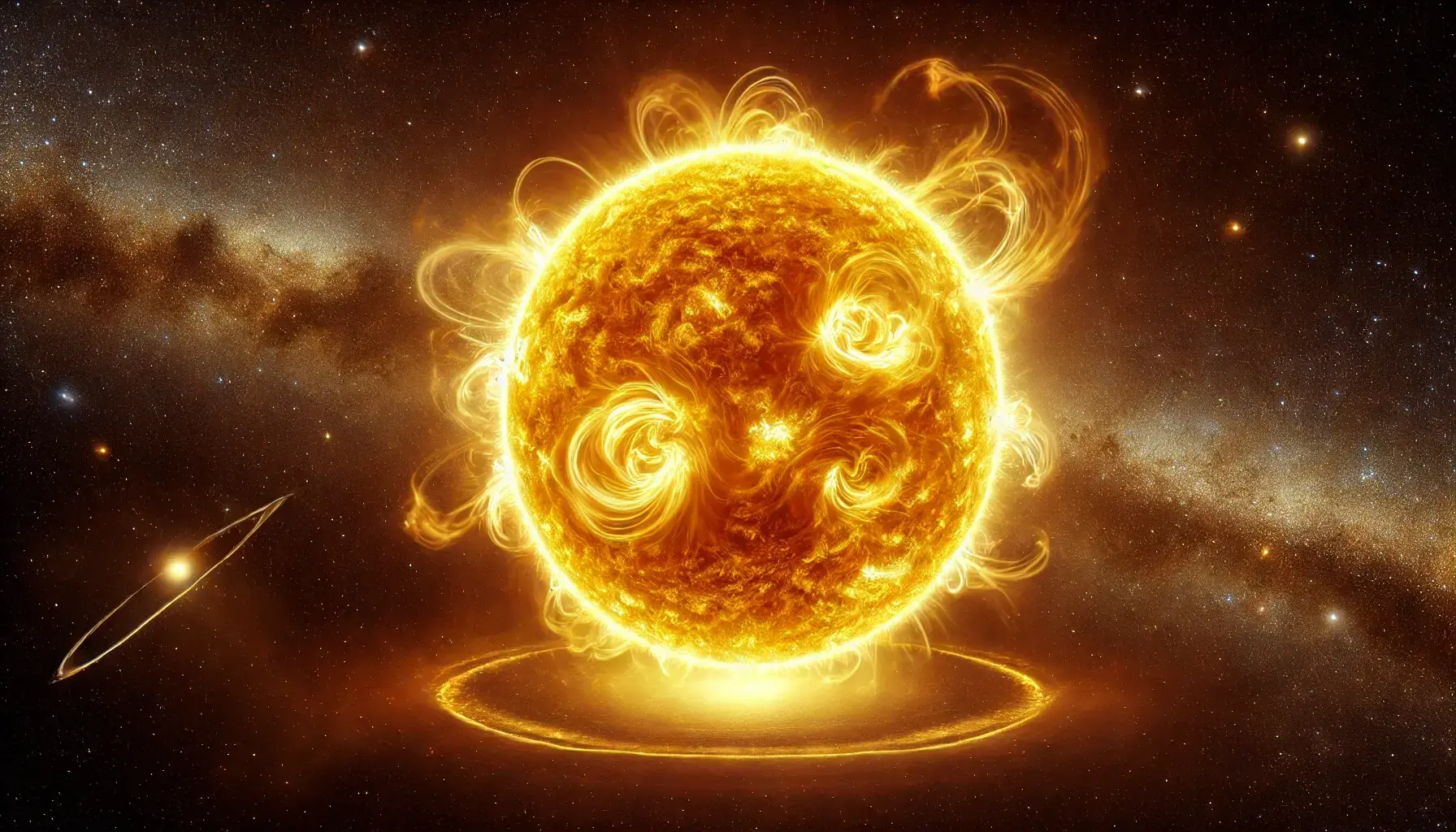
A G2V-type star belongs to the main sequence of the Hertzsprung-Russell diagram. It is classified as a yellow dwarf, with an average surface temperature, producing light that is white to slightly yellowish.
Structure
It has a core where hydrogen fuses into helium through the proton-proton chain. The core is surrounded by a radiative zone that transports energy via photon diffusion, followed by a convective zone that delivers heat to the surface.
Functioning
The star’s radiation is governed by hydrostatic equilibrium, where the internal pressure from fusion counterbalances gravity. The energy production is relatively stable, enabling continuous emission of light and heat over long timescales.
Evolution
A G2V star remains for billions of years in the main sequence. When the hydrogen in the core is depleted, it evolves into the subgiant phase and then into a red giant, altering its internal structure and radiation output.
Limits
This type of star cannot sustain fusion indefinitely. Its characteristics depend on its initial mass: if too small, it would be of type K or M; if larger, it would belong to types F or A. Its current equilibrium is a transitional phase of the stellar cycle.