Definition
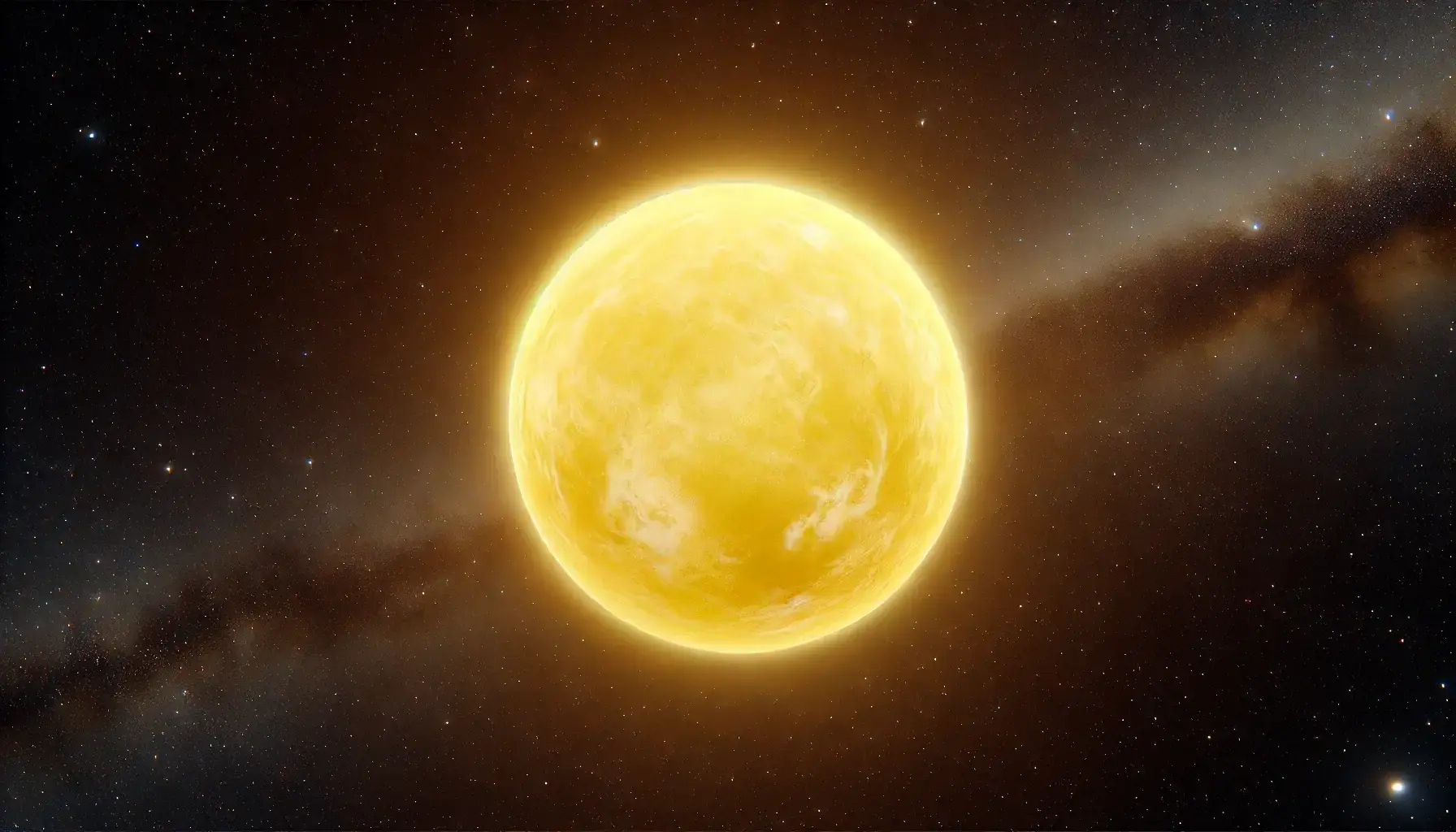
A yellow dwarf star is a type of main-sequence star characterized by medium mass and luminosity. Its apparent color results from the emission of light whose spectrum is centered in the yellow-white range.
Structure
It has a core where hydrogen fusion occurs, a radiative zone, a convective zone, and a photosphere that forms the visible surface. Its composition is mainly hydrogen and helium, with traces of heavier elements.
Functioning
Energy production occurs through nuclear fusion, mainly via the proton-proton chain. This energy spreads outward and reaches the surface as electromagnetic radiation, the visible part of which corresponds to yellow-white light.
Evolution
During its lifetime, a yellow dwarf slowly consumes its hydrogen. When it becomes depleted in the core, the star transforms into a red giant, then ejects its outer layers and leaves behind a white dwarf.
Limits
Yellow dwarfs differ from more massive stars by having a longer lifespan and more moderate brightness. They differ from smaller stars by having higher temperature and energy. Their place lies in a stable range between these two stellar extremes.